
Scope 3 Emissions Data in Procurement: From Reporting to Sourcing Decisions
Learn how Scope 3 emissions data is used in procurement, why supplier emissions matter, and how sourcing decisions impact ESG and compliance.


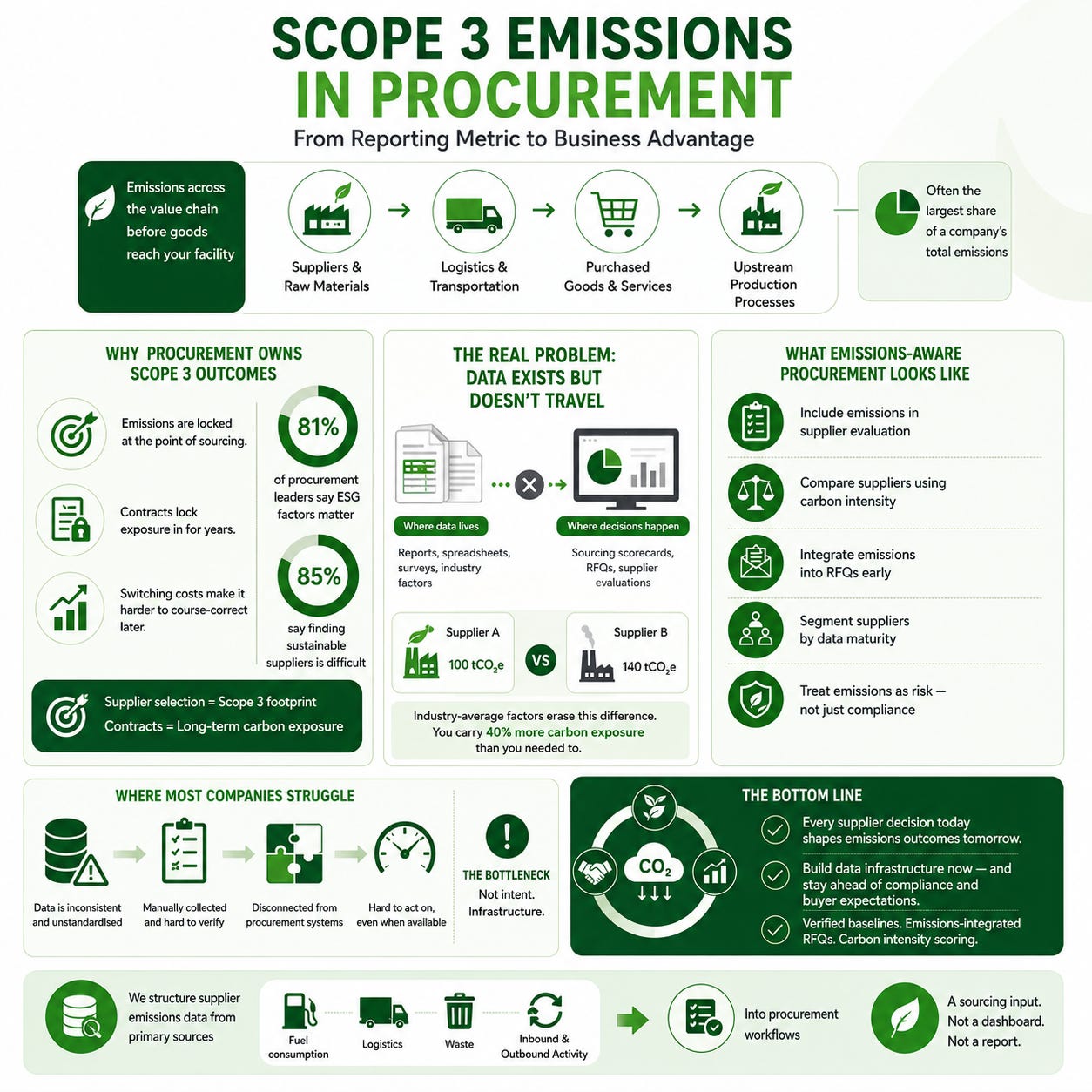
Scope 3 emissions in procurement refer to the indirect carbon footprint embedded in sourcing decisions. These refer to the emissions produced by suppliers, logistics providers, and raw material producers before goods reach your facility. Under India's BRSR Core requirements and global ESG disclosure frameworks, Scope 3 is no longer a reporting metric. It is a procurement input — and the companies that treat it as one are gaining measurable advantages in compliance readiness, cost control, and supplier risk management.
In most organisations, the data already exists, ESG dashboards, supplier surveys, consultant spreadsheets, internal reports. But when procurement teams evaluate suppliers or run RFQs, that data rarely plays a role.
And that is the gap.
Scope 3 emissions is no longer just an ESG reporting metric. It is becoming a procurement input directly linked to supplier selection, cost exposure, and compliance risk. Yet in most companies, emissions data still sits in reports, not in sourcing decisions.
What is Scope 3 emissions in procurement?
Scope 3 emissions refer to indirect emissions across the value chain, including:
suppliers and raw materials
logistics and transportation
purchased goods and services
upstream production processes
In procurement, it represents the embedded carbon footprint of sourcing decisions.
It is often the largest share of a company’s total emissions footprint. Academic research also highlights that Scope 3 emissions remain the most complex category to measure due to data gaps and inconsistent supplier-level reporting.
Why Procurement Owns Scope 3 Outcomes — Not Sustainability
The most common misconception is that Scope 3 is a sustainability team responsibility. It is not. Emissions are locked at the point of sourcing.
Once a supplier is selected, their carbon intensity is embedded into your footprint. Contracts lock that exposure in for years. Switching costs make it harder to course-correct later. Research shows that 81% of procurement leaders say ESG factors matter in purchasing decisions, yet 85% say finding sustainable suppliers is difficult. That gap exists because procurement systems are still built around cost, quality, and delivery — not emissions.
Supplier selection is Scope 3 footprint. Procurement decisions are emissions outcomes. Contracts are long-term carbon exposure.
The Real Problem: Scope 3 Data Exists But Doesn’t Travel
Most companies have Scope 3 data in some form — ESG reports, Excel carbon models, supplier questionnaires, industry-average emission factors. The problem is where it lives. It sits in sustainability reports, not in sourcing scorecards.
Two suppliers can offer the same product at the same price with carbon footprints that differ by 40%. Industry-average emission factors — which most companies still use — erase that difference entirely. You make a sourcing decision that looks identical on paper and carry 40% more carbon exposure than you needed to.
That is not a data availability problem. It is a data integration problem.
What Emissions-Aware Procurement Actually Looks Like
Include emissions in supplier evaluation. Emissions per unit should sit alongside cost and quality in scoring — not in a separate ESG report that procurement never opens.
Compare suppliers using carbon intensity, not just price. A lower-cost supplier may carry significantly higher emissions exposure — especially relevant as BRSR Core mandates verified value chain disclosures and carbon pricing mechanisms mature.
Integrate emissions into RFQs from the start. Not after supplier selection, not at annual review — at the point where the decision is still open.
Segment suppliers by data maturity. Verified emissions data suppliers, partially reported suppliers, and no-data suppliers each require a different sourcing approach. Treating them identically creates both compliance risk and missed reduction opportunities.
Treat emissions as risk — not just compliance input. Carbon exposure is compliance risk, cost risk under CBAM, and reputational risk when global buyers embed sustainability into their own supplier onboarding.
Where Most Companies Actually Struggle
The challenge is not awareness. Most procurement leaders understand why Scope 3 matters. The challenge is operationalisation.
Supplier emissions data is inconsistent, unstandardised, manually collected, and disconnected from procurement systems. So even when companies want to use it, they cannot act on it. The bottleneck is not intent — it is infrastructure.
Most Scope 3 disclosures today rely on layered estimates, and regulators are increasingly questioning their reliability. That scrutiny will only intensify as BRSR Core enforcement tightens and global buyers move from asking for sustainability commitments to asking for verified data.
The Bottom Line
Every supplier decision made today directly shapes emissions outcomes tomorrow. The companies building data infrastructure now — verified supplier baselines, emissions-integrated RFQs, carbon intensity scoring — will be ahead when compliance pressure and buyer expectations converge.
Fitsol structures supplier emissions data from primary sources — fuel consumption, logistics, waste, inbound and outbound activity — and brings it into procurement workflows where it can actually influence decisions. Not a dashboard. Not a report. A sourcing input.
If your Scope 3 data exists but never makes it into a sourcing decision, the infrastructure is the problem — not the intent.
FAQs
1. What is Scope 3 emissions in procurement?
Indirect emissions from suppliers and the supply chain that influence sourcing decisions.
2. Why is supplier emissions data important?
It helps evaluate carbon exposure, compliance risk, and supplier efficiency.
3. How is Scope 3 data used in sourcing decisions?
In most companies, it is still not fully used. Ideally, it should be part of RFQs, supplier evaluation, and procurement scoring.
What is the biggest barrier to emissions-aware procurement in your organisation: supplier data availability, data quality, internal processes, or procurement priorities? (Answer in the comment section.)
Join our LinkedIn community, The Decarbonisation Exchange: Procurement · Supply Chain · Sustainability, and WhatsApp network, Net Zero Community, for ongoing discussions, insights, and updates.