
CPCB EPR Dashboard Issues: Common Problems and Compliance Solutions
Struggling with CPCB EPR dashboard mismatches? Understand EPR targets, pending obligations, certificate visibility, reporting gaps, and practical ways to improve compliance tracking.


Nobody opens the CPCB EPR dashboard expecting a problem. Then suddenly: targets look incomplete, certificate quantities don’t match, recycler entries disappear, or the numbers simply stop making sense. That’s usually when the panic starts.
The CPCB EPR dashboard is supposed to help businesses track targets, certificates, recovery obligations, and compliance progress. Most days, it does. But when quantities don’t match, obligations remain pending, or certificates stop reflecting as expected, the dashboard quickly becomes more than a reporting tool. It becomes a compliance issue that needs attention.
The problem is, many businesses still treat the CPCB EPR dashboard like a reporting portal. In reality, it has slowly become an operational compliance system, and small mismatches can create larger compliance problems later.
Under India’s Plastic Waste Management Rules and CPCB’s EPR framework, businesses are increasingly expected to maintain visibility across recovery, reporting, and certificate management workflows, making dashboard monitoring more operational than procedural.
Why do CPCB EPR dashboard numbers not match?
CPCB EPR dashboard mismatches are usually caused by delayed certificate processing, recycler-side reporting gaps, documentation issues, reconciliation errors, or reporting delays. Businesses should monitor dashboard metrics regularly, reconcile recycler data continuously, and maintain visibility over certificate and reporting workflows throughout the compliance cycle.
The Metrics Most Companies Actually Need to Watch
Not every number on the dashboard matters equally. But these usually create the biggest operational issues:
EPR Targets
This is the total obligation your business is expected to fulfil. A lot of companies only check whether the target exists. Very few actively track whether recovery and certificate procurement are moving fast enough against it.
That gap becomes risky closer to reporting deadlines.
Processed Quantity vs Uploaded Quantity
This is where confusion happens most often. Sometimes:
certificates are uploaded but not processed yet
recycler entries don’t reflect immediately
quantities mismatch across uploads
reporting timelines create delays
The issue is usually not intent. It’s operational coordination.
Pending Obligations
This metric quietly becomes a problem for many businesses. Because pending obligations are not always caused by “non-compliance.” Sometimes the reason is:
delayed documentation
incorrect uploads
certificate mismatch
recycler-side reporting gaps
reconciliation issues
And most teams notice it very late.
Certificate Visibility
A lot of businesses assume: “if the certificate was purchased, the work is done.” Not always.
Certificate visibility, reconciliation, and validation matter just as much operationally. Especially when reporting periods get closer.
What Usually Goes Wrong Operationally
Most EPR dashboard problems are not caused by lack of effort. They happen because:
compliance workflows are fragmented
recycler coordination is inconsistent
reporting timelines slip
documentation is not tracked properly
teams work reactively instead of continuously
That’s why businesses often end up checking the dashboard only during compliance pressure moments.
So What Should Businesses Actually Do?
A few things help immediately:
Track dashboard metrics regularly, not just before deadlines
Reconcile recycler data continuously
Maintain visibility on uploaded vs processed quantities
Keep documentation structured and audit-ready
Treat EPR tracking as an operational process, not a one-time reporting task
Because once numbers start looking wrong on the CPCB EPR dashboard, fixing them is rarely instant.
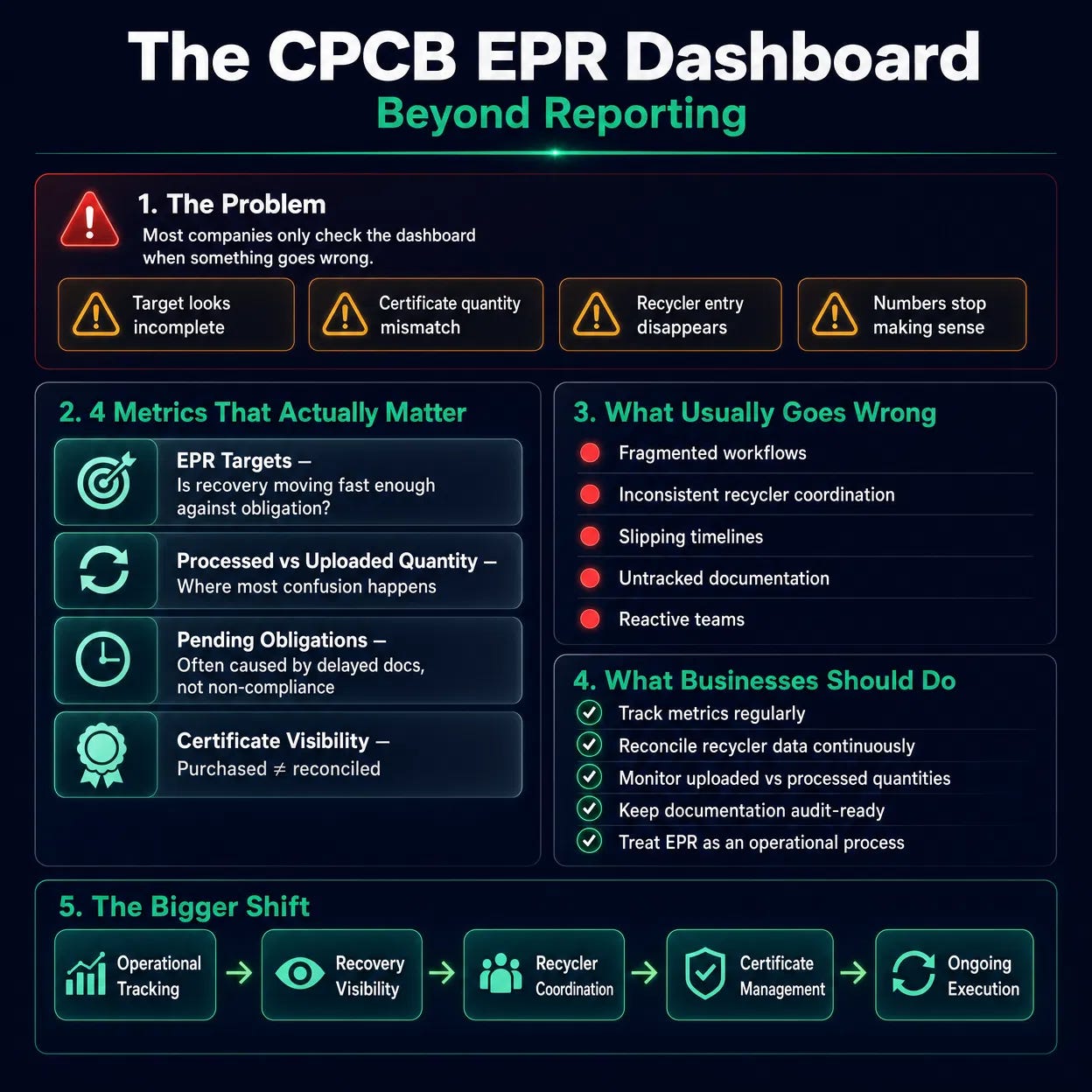
The Bigger Shift Happening Quietly
EPR compliance is no longer just about filing reports.
It’s becoming:
operational tracking
recovery visibility
recycler coordination
certificate management
and ongoing compliance execution
The businesses handling this well are usually the ones treating compliance as a continuous operational workflow, not a last-minute activity.
Industry discussions around EPR implementation have increasingly highlighted the importance of continuous compliance tracking, data visibility, and operational coordination across recycling and recovery ecosystems.
How Fitsol Helps
At Fitsol, we work with businesses on EPR execution, compliance visibility, certificate management, reporting workflows, and operational sustainability support. Because most compliance problems today are not caused by regulations alone. They happen when operational visibility breaks down.
FAQs
Why do CPCB EPR dashboard numbers sometimes not match?
Usually because of delayed processing, recycler-side reporting gaps, reconciliation issues, or documentation mismatches.
How often should businesses monitor the CPCB EPR dashboard?
Ideally throughout the reporting cycle, not only near compliance deadlines.
What causes pending EPR obligations?
Pending obligations can happen due to incomplete recovery documentation, delayed uploads, certificate mismatch, or reporting delays.
Is buying EPR certificates enough for compliance?
Not always. Certificate visibility, reconciliation, and reporting alignment also matter operationally.
Are businesses really managing EPR compliance operationally or only reacting when the dashboard starts showing problems? (Answer in the comment section.)
Join our LinkedIn community, The Decarbonisation Exchange: Procurement · Supply Chain · Sustainability, and WhatsApp network, Net Zero Community, for ongoing discussions, insights, and updates.